 Translate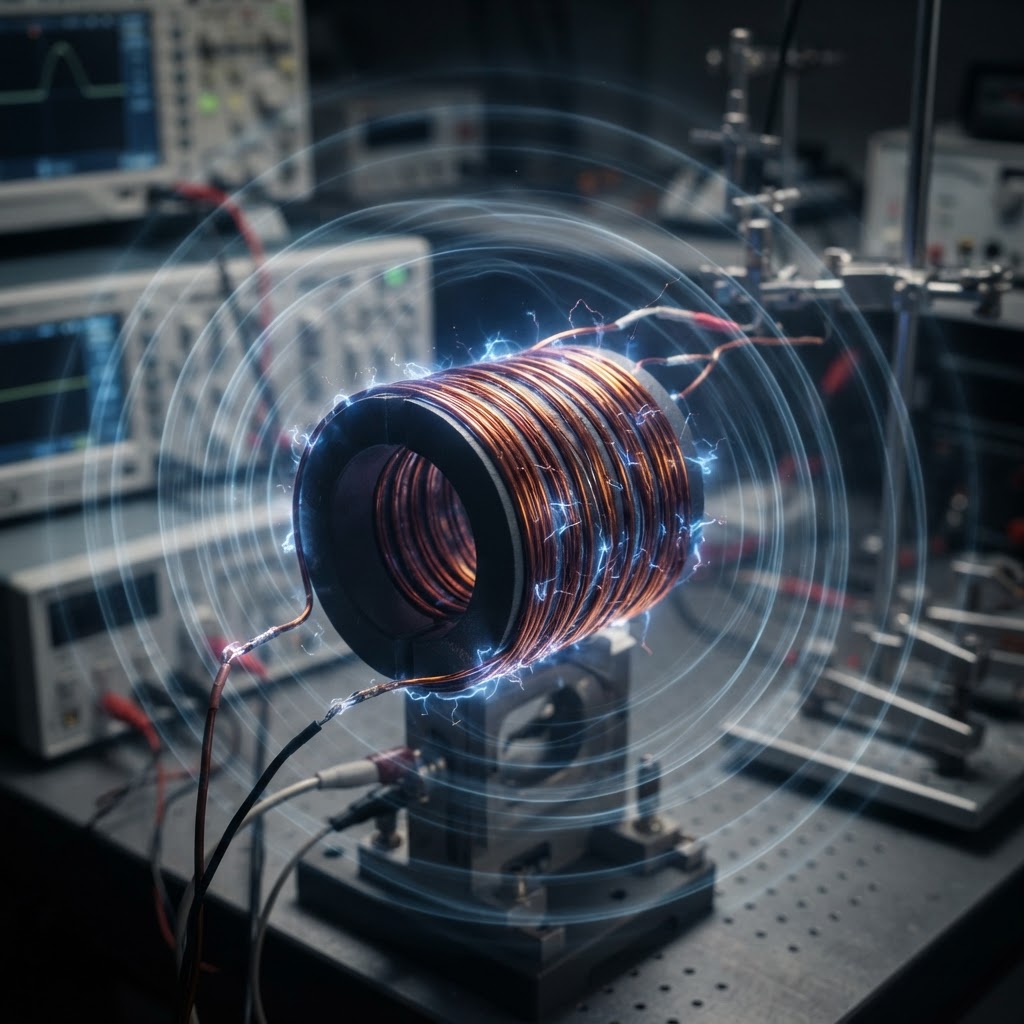
Principles of Electromagnetic Induction: The Lenz-Faraday Interaction
Understand how changing magnetic flux induces electromotive force and drives modern electrical power systems.
The Mechanism of Induction
At its core, electromagnetic induction is the process where a conductor placed in a time-varying magnetic field experiences an induced electromotive force (EMF). This fundamental phenomenon is governed by Faraday’s Law of Induction, which states that the induced EMF in a closed circuit is directly proportional to the time rate of change of the magnetic flux through the loop. Mathematically, this is expressed as ε = -dΦ/dt, where Φ represents magnetic flux.
Lenz’s Law and Conservation
The negative sign in the equation represents Lenz’s Law. It dictates that the direction of the induced current is always such that it opposes the change in magnetic flux that produced it. From a professional engineering perspective, this is a beautiful manifestation of the law of conservation of energy. If the induced current acted to reinforce the change, it would lead to a runaway feedback loop, violating basic energy principles. Instead, the system resists the change, requiring mechanical work to overcome this electromagnetic opposition.
Applications in Power Systems
This interaction is the cornerstone of electrical engineering. In an electric generator, mechanical energy—be it from a turbine, a wind blade, or a hydroelectric flow—is used to rotate a conductor within a magnetic field. This rotation creates a continuous change in flux, forcing electrons to move and generating a steady AC current. Conversely, in a transformer, we eliminate the mechanical motion entirely. By using a time-varying current in a primary coil, we create a time-varying magnetic field within a shared core, which in turn induces an EMF in the secondary coil. This allows for efficient voltage stepping, the backbone of modern power distribution grids. Mastery of these dynamics allows engineers to optimize winding density, core material selection, and frequency stability, ensuring efficiency in everything from power transmission to high-frequency communication circuits.
Try this at home
The Copper Tube Test
- Take a 1-foot long hollow copper pipe and a small, strong neodymium magnet that fits inside.
- Drop the magnet through the pipe and observe its slow, 'viscous' descent compared to a free fall.
- The falling magnet induces eddy currents in the copper walls; according to Lenz's Law, these currents create an opposing magnetic field that acts as a magnetic brake.
