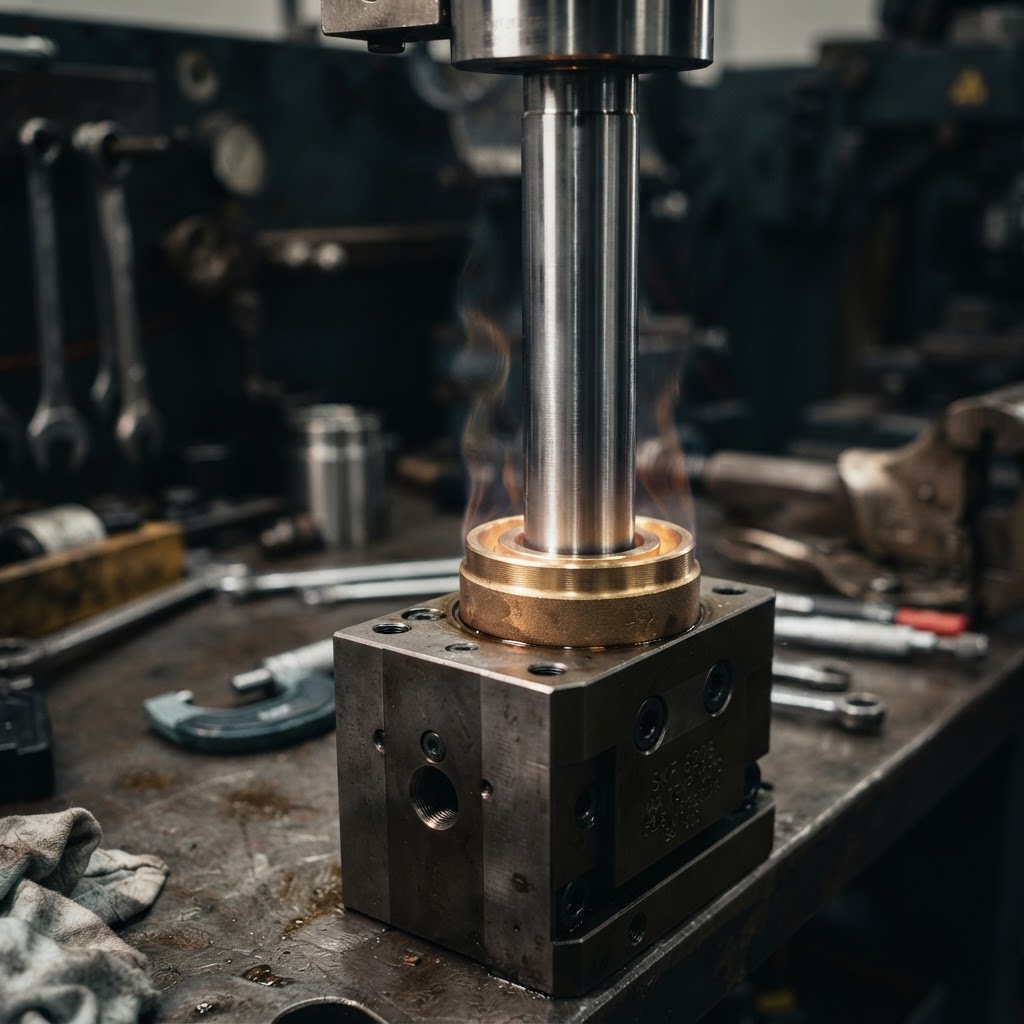
Fundamentals of Interference Fits
Mastering the mechanical precision of securing components using internal stress and thermal expansion.
The Principle of Interference
In mechanical assembly, an interference fit—also known as a press fit—is a fastening method that achieves friction-based locking by sizing the internal member (the shaft) slightly larger than the external member (the hole). Unlike bolted or keyed connections that rely on mechanical barriers to prevent slippage, interference fits leverage the elastic deformation of materials to generate massive normal forces. When the two parts are mated, the shaft is compressed and the housing is expanded, creating a high-pressure contact zone that resists relative axial and rotational motion.
Elastic Deformation and Stress
At the microscopic level, interference fits are a study in hoop stress and radial pressure. The assembly remains functional only as long as the material stays within its elastic limit. If the interference is too aggressive, the materials may undergo plastic deformation or yield, leading to permanent galling or structural cracking. Engineers must consult tolerance standards, such as ISO or ANSI fits (e.g., FN1 to FN5), to calculate the exact 'allowance' required. This calculation accounts for the modulus of elasticity, Poisson's ratio, and the thermal expansion coefficients of the specific materials being joined.
Thermal Assembly Techniques
To facilitate the assembly of tight-tolerance fits, engineers utilize the thermal properties of metals. By heating the housing (expanding the bore) or cryogenically cooling the shaft (shrinking the diameter), the required installation force is reduced to near zero. This 'shrink fit' is widely utilized in aerospace and automotive industries—most notably for seating cylinder liners or securing turbine blades into rotor disks. Once the temperatures equalize, the material seeks its original state, locking the two components together with a bond stronger than many welding techniques. Understanding the interplay between temperature differentials and dimensional change is essential for any engineer working in precision manufacturing, as it allows for the structural integration of components without introducing the heat-affected zones or fatigue points commonly associated with welding or brazing.
Try this at home
Thermal Expansion Demonstration
Take a tight-fitting metal bolt and a corresponding nut. Attempt to push the bolt through a slightly smaller metal washer. Use a pair of pliers to hold the washer over a stovetop flame for two minutes, then quickly attempt to drop the bolt through the hole. Observe how thermal expansion temporarily alters the tolerance to allow for easier passage.