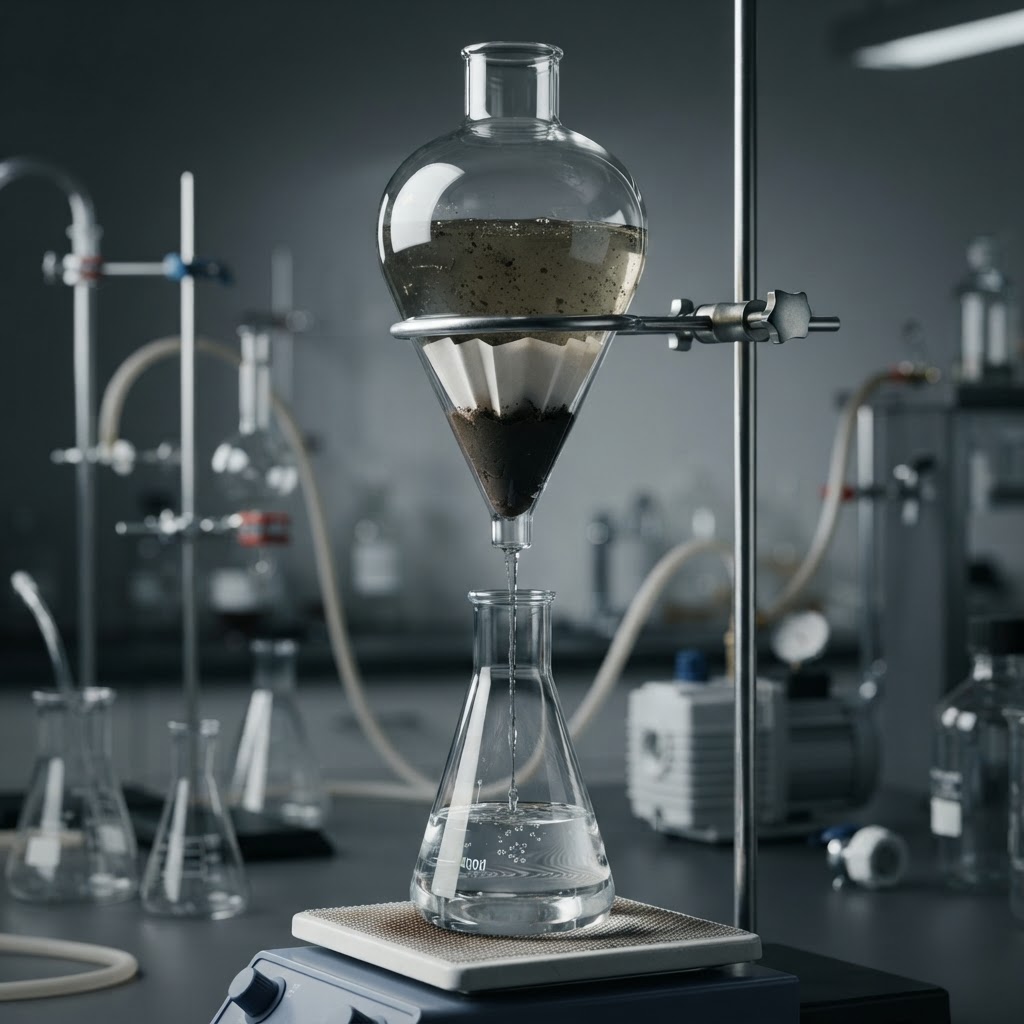
The Art of Particle Separation: Sedimentation
Explore how gravity and density differences allow engineers to separate solids from liquids in industrial processes.
Gravity as a Separator
In chemical engineering, one of the most fundamental challenges is separating substances that have been mixed together. While distillation uses boiling points and filtration uses physical barriers, sedimentation relies on the simple, constant force of gravity. Sedimentation is the process by which solid particles in a liquid suspension settle to the bottom of a container due to their higher density compared to the fluid.
The Engineering Principles
At the core of sedimentation is Stokes' Law. This physical principle describes how particles move through a viscous fluid. If a particle is denser than the surrounding liquid, gravity pulls it downward. However, the liquid exerts a 'drag force' that acts in the opposite direction, resisting the particle's movement.
Chemical engineers design large vessels called clarifiers or settlers to maximize this process. By controlling the velocity of the fluid moving through the tank, engineers ensure the liquid stays calm enough for the particles to lose their momentum and sink. If the fluid moves too quickly—a phenomenon known as turbulence—it keeps the particles suspended, preventing separation. Once the particles reach the bottom, they form a 'sludge' that can be removed, leaving behind a clarified liquid at the top.
Why It Matters
This process is vital across many industries. In water treatment plants, sedimentation is used to remove dirt and impurities from drinking water. In the food industry, it is used to clarify juices and oils. By understanding the relationship between particle size, fluid viscosity, and settling velocity, engineers can scale these processes from a single beaker to massive industrial ponds, ensuring that we have clean resources for daily life.
Try this at home
Fill a clear glass jar with water and add two tablespoons of sand or dirt. Stir it vigorously with a spoon and then place it on a flat surface. Observe the mixture over the next 30 minutes. You will see the largest, densest particles settle first, followed by finer particles, eventually leaving a clear layer of water on top. This demonstrates the principle of gravitational settling in action.