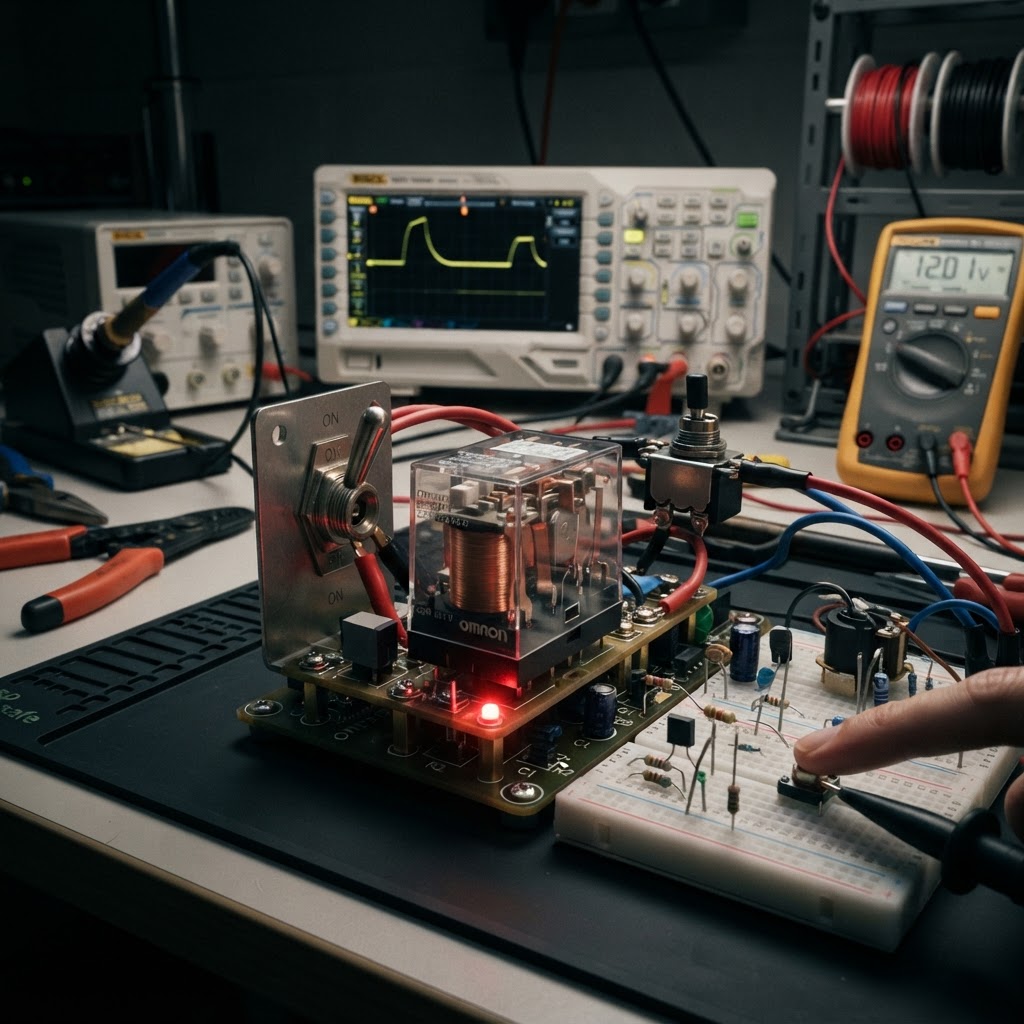
Switches and Relays: Controlling the Flow
Master the art of logic control using mechanical and electrical switches.
Simple Switching
A switch is the most basic way to control a circuit. By physically breaking or bridging a gap in the conductive path, a switch gives the user control over when current flows. Whether it's a toggle switch on a lamp or a push button on a game controller, switches turn 'dumb' circuits into interactive tools.
Introducing the Relay
A relay is a clever device: it is an electromagnetic switch. It uses a small amount of electricity to power a magnet, which then physically moves a lever to close a high-power circuit. This allows a small, low-voltage controller (like a computer) to safely manage a high-voltage machine (like a motor or a heater) without the risk of electrical feedback.
Logic in Motion
Switches are the foundation of computer logic. By combining multiple switches in series or parallel, engineers create logic gates that can perform complex calculations. Even the most powerful supercomputer is essentially a massive, highly organized collection of microscopic switches turning on and off at incredible speeds.
Try this at home
Create your own 'gravity switch' using a piece of cardboard, two aluminum foil strips, and a small ball bearing. Fold the cardboard to create a slight slope. Place the foil strips at the bottom, but leave a tiny gap between them. When the ball bearing rolls down the slope and lands on the strips, it bridges the gap and completes the circuit. You can wire this into your battery and LED setup to turn the light on automatically whenever the ball rolls down!