 Translate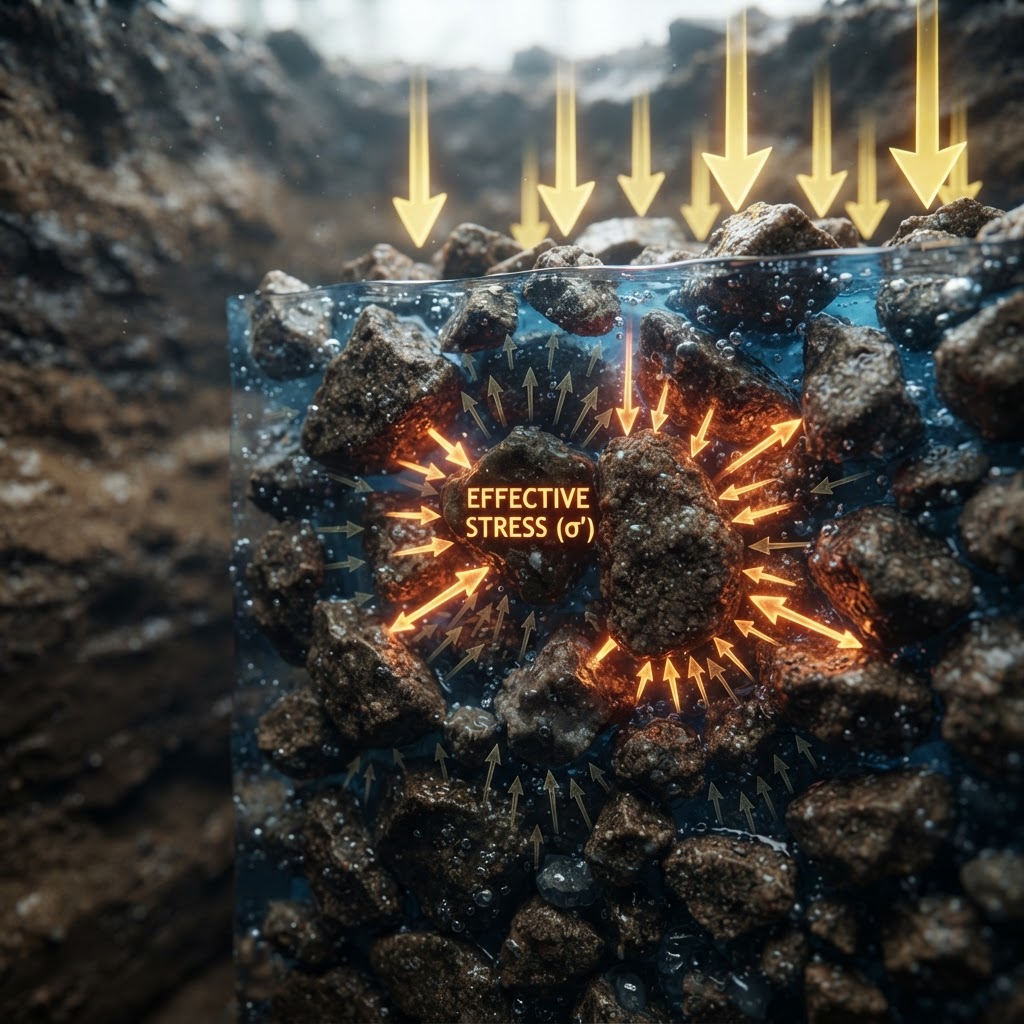
Effective Stress: The Secret Force Within
Understand how water pressure influences the strength of the ground.
What is Effective Stress?
Effective stress is the fundamental concept that governs the strength of soil. It represents the actual contact force transmitted between individual soil particles. Because soil is a porous medium, the space between grains is often filled with water. This pore water exerts a pressure known as pore water pressure. The total stress acting on the soil is shared between the soil particles (effective stress) and the water (pore pressure).
The Role of Pore Water
When you apply a load to a soil deposit, such as building a house, the total stress increases. If the soil is sandy and free-draining, water can quickly escape, and the effective stress increases proportionally. However, in low-permeability soils like clay, water cannot escape easily. The water 'traps' the load, which can lead to instability and excessive settlement over time. Engineers must carefully monitor these pressures to prevent structural damage.
Engineering Implications
By understanding effective stress, engineers can predict how quickly a soil will settle. This is critical for large-scale projects like highway embankments or dams. If we can control how the water drains from the soil—a process called consolidation—we can prepare the ground to handle heavy loads safely. Mastering this concept is essential for any geotechnical engineer working in areas with high water tables.
Try this at home
Fill a kitchen sponge with water and place it on a flat surface. When you press down on the sponge with your hand, you feel resistance; this is like effective stress. Now, place the wet sponge inside a thin plastic bag and seal it tightly so no water escapes. When you press on the sealed sponge, it feels much firmer and harder to compress because the trapped water cannot move out of the way. This demonstrates how pore water pressure prevents soil from compacting quickly under a load. Try it again with a dry sponge and compare the difference in how the 'soil skeleton' supports the weight when water is trapped versus when it can drain freely.
