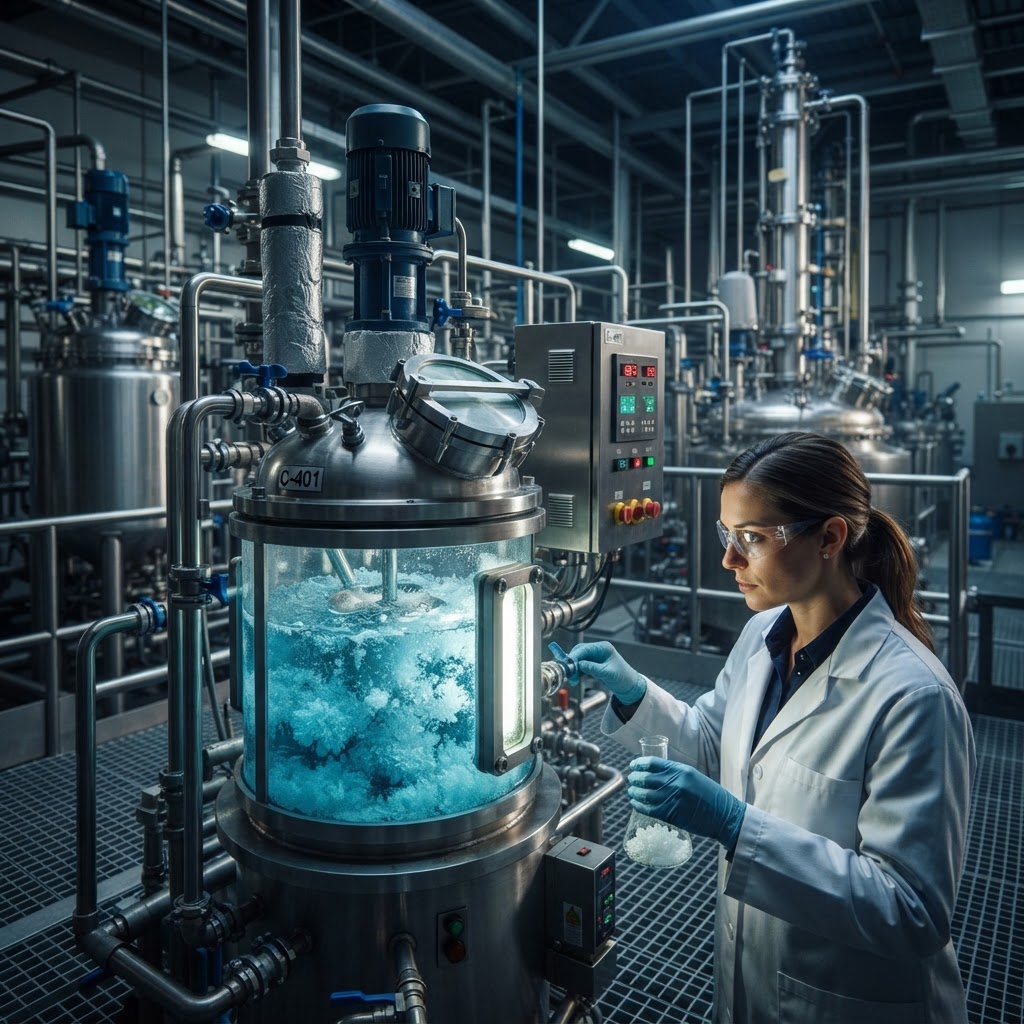
The Power of Crystallization
Discover how engineering creates pure solid crystals from liquids.
The Solid State
Crystallization is a process that turns liquid solutions into pure solid crystals. From the salt on your table to the medicine in your cabinet, crystallization is a vital method for purifying chemicals and materials.
Solubility Limits
This process is driven by solubility—the maximum amount of a solute that can dissolve in a solvent at a given temperature. When a solution is cooled or when some solvent is evaporated, the concentration exceeds the solubility limit. At this point, the solute comes out of the solution in the form of organized, solid crystals.
Controlled Growth
Engineers control the rate of cooling and the agitation of the solution to dictate the size and purity of the crystals. If you cool a solution too quickly, you get many tiny, impure crystals. If you cool it slowly, you get large, highly pure crystals. This fine-tuned control is critical in the pharmaceutical industry, where the size and structure of a drug molecule can change how it interacts with the human body.
Try this at home
Grow your own sugar crystals (rock candy). Dissolve as much sugar as you can in a cup of boiling water until no more will dissolve (a supersaturated solution). Pour this into a glass and suspend a string or a wooden skewer inside. Let it sit undisturbed for a few days. As the water slowly evaporates, the sugar molecules will settle out of the liquid and bond to the string in a structured crystalline lattice. This demonstrates how controlled supersaturation leads to organized crystal growth.