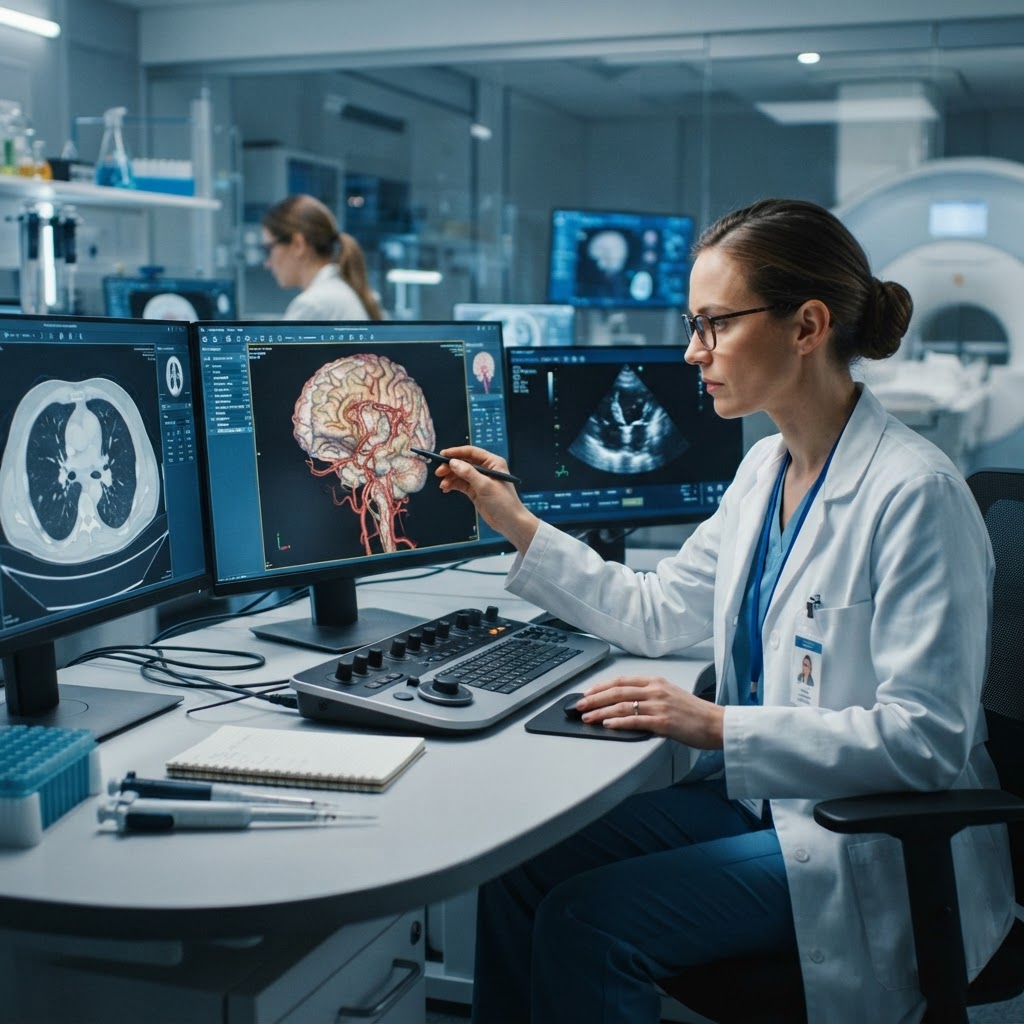
Medical Imaging: Seeing Inside the Body
Exploring the technology behind X-rays and ultrasound.
From Shadows to Signals
Medical imaging is the cornerstone of modern diagnosis, allowing us to 'see' inside the body without a scalpel. Engineers approach imaging by choosing a type of energy that can interact with biological tissues. X-rays use high-energy radiation to pass through soft tissues but get blocked by dense materials like bone. This creates a shadow image, much like a traditional film photograph.
The Echo Approach
Ultrasound works on an entirely different principle. Instead of radiation, it uses sound waves that are too high-pitched for humans to hear. Engineers design transducers that send pulses of sound into the body. When these waves hit an interface—like the border between an organ and a fluid—they bounce back. By measuring how long it takes for the echo to return, the computer can construct a detailed image of soft tissues like the heart, liver, or a developing fetus.
The Engineering Trade-off
Every imaging modality has pros and cons. X-rays are fast and great for bones but involve ionizing radiation, which can damage DNA. Ultrasound is safe and portable but struggles to penetrate bone or air-filled lungs. Biomedical engineers spend their careers improving these technologies, creating better resolution, faster processing times, and safer methods to ensure doctors get the best possible view of the patient's internal anatomy.
Try this at home
To understand the principle of 'echo' imaging, find a large, empty room or a hallway. Stand at one end and clap your hands once while recording a video. Listen to the echo produced when the sound hits the wall. Now, place a soft object like a thick blanket or a pillow in the middle of the room. Clap again. You will notice that the sound is absorbed rather than reflected, similar to how an ultrasound technician has to maneuver around bones or air pockets to get a clear image of an organ. This experiment demonstrates how pulse-echo systems detect boundaries and densities.