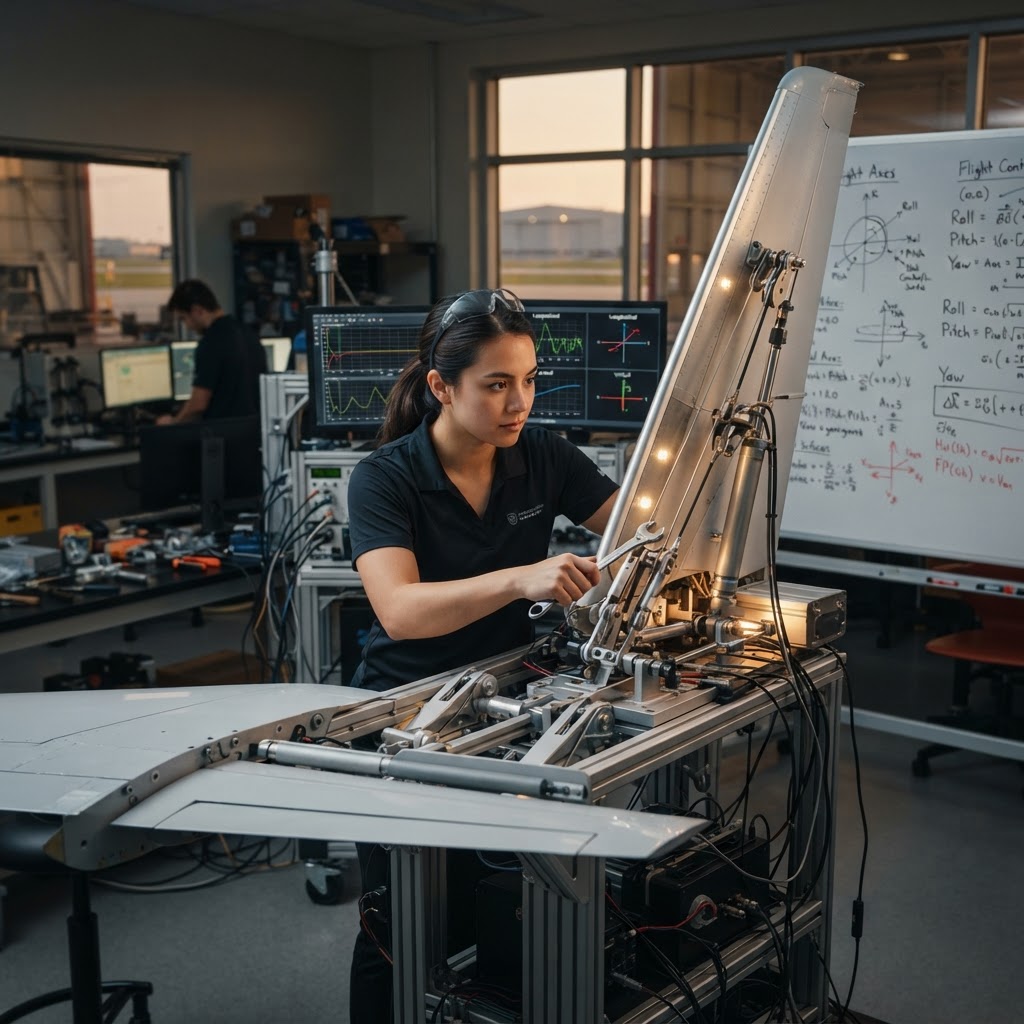
Flight Controls: Navigating the Three Axes
How do pilots steer? Learn about pitch, roll, and yaw in the skies.
Understanding the Three Axes
To move in three-dimensional space, an aircraft must be able to rotate around its center of gravity. Aerospace engineers define these motions using three axes: the longitudinal axis (nose to tail), the lateral axis (wingtip to wingtip), and the vertical axis (top to bottom). Controlling these rotations allows the pilot to steer the aircraft precisely through the air.
The Control Surfaces
Each axis is governed by a specific set of moving control surfaces on the wings and tail. Pitch, which is the upward or downward movement of the nose, is controlled by the elevators located on the horizontal stabilizer of the tail. Roll, the tipping of the wings, is controlled by ailerons on the trailing edges of the wings. Finally, yaw, which is the side-to-side movement of the nose, is managed by the rudder on the vertical stabilizer.
Fly-by-Wire Technology
In modern aircraft, pilots rarely move these surfaces by physical cables. Instead, they use 'fly-by-wire' systems. When a pilot moves the flight stick, an electronic signal is sent to onboard computers, which then calculate the precise movement required by the hydraulic actuators at each control surface. This not only makes the aircraft easier to fly but also allows for 'stability augmentation,' where the computer makes micro-adjustments to ensure the flight remains smooth even in turbulent conditions.
Try this at home
Use your hands to model the axes. Hold your arms out to your sides. Tilting your body forward or backward is 'pitch.' Tilting your body left or right is 'roll.' Turning your torso left or right while keeping your feet planted is 'yaw.' Now, visualize a plane. If you had a flap on your tail that pushed up, your nose would go down—that is how the elevator works. Practice this with your arms until you understand how each movement corresponds to the different control surfaces.