Why Bridges Don't Fall Down
The quiet battle between weight and support.
A bridge has one job: hold itself up while carrying stuff across a gap. The enemy is gravity, pulling everything down. Engineers fight it with two main ideas: compression and tension.
- Compression is a squeezing force — a column of stone pushes down, and the stone pushes back.
- Tension is a pulling force — a steel cable being stretched.
Different bridge shapes use these forces differently:
A beam bridge is the simplest — a stiff beam resting on two supports. The top of the beam gets squeezed (compression); the bottom gets stretched (tension). It works, but it can't span very far before the beam sags.
A truss bridge adds a web of triangles. Triangles are rigid — push on one corner and the force spreads through the whole shape. That lets the bridge carry more without bending.
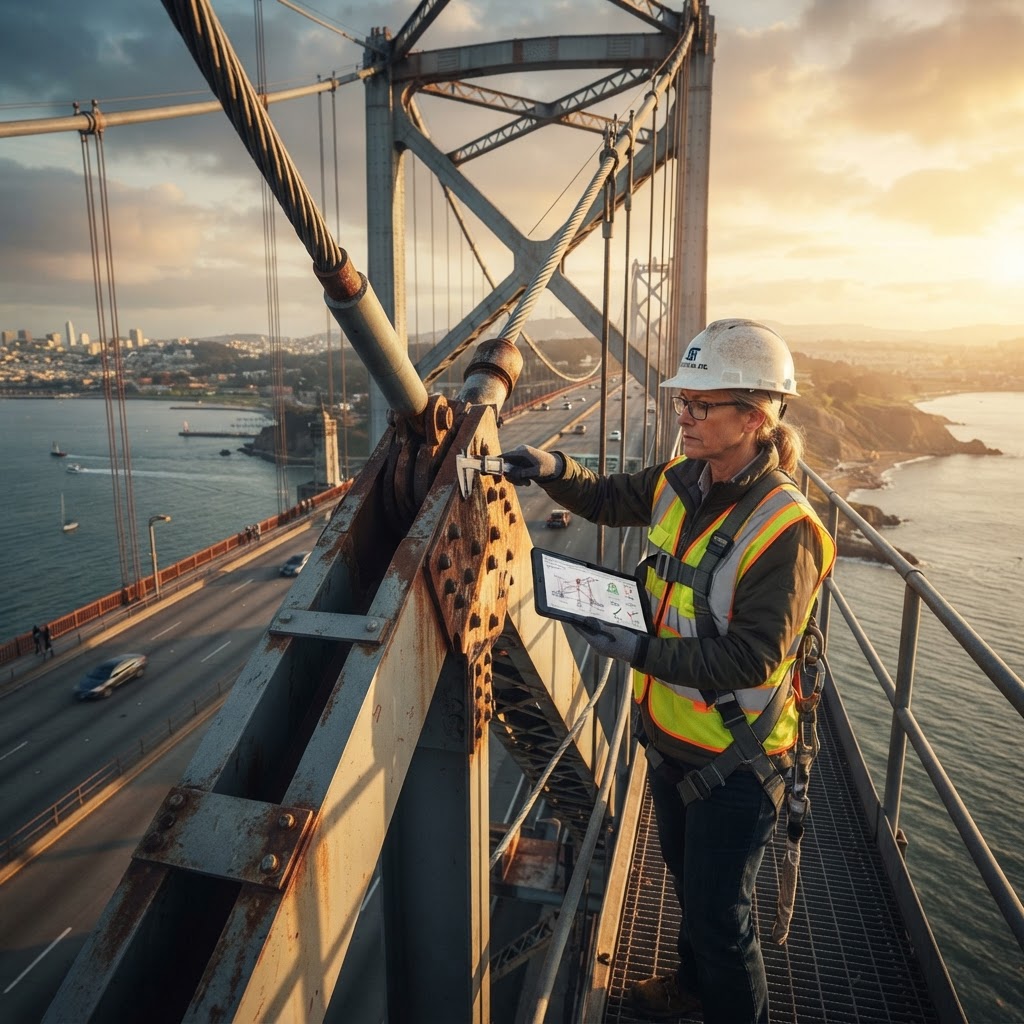
A suspension bridge (like the Golden Gate) hangs the road from huge main cables strung between towers. The cables are in tension; the towers are in compression. This design can span enormous distances because the cables carry the load to the towers and down into the ground.
The secret to every bridge: every force has to go somewhere. A car's weight flows through the deck, into the cables or beams, into the supports, and finally into the bedrock below. Engineers call this the load path — and if any link in that path is weak, the whole bridge is in trouble.
Try this at home
Build a load path. Lay a ruler across two books (a beam bridge). Push down in the middle — it bends. Now add a third book under the center. It barely bends at all, because the force now flows down into that middle support.
Test a triangle: cut three strips of cardboard and tape them into a triangle. Try to squash it — it's surprisingly stiff. Now cut one side and try again. That's why trusses use triangles: they can't be deformed without breaking a side.