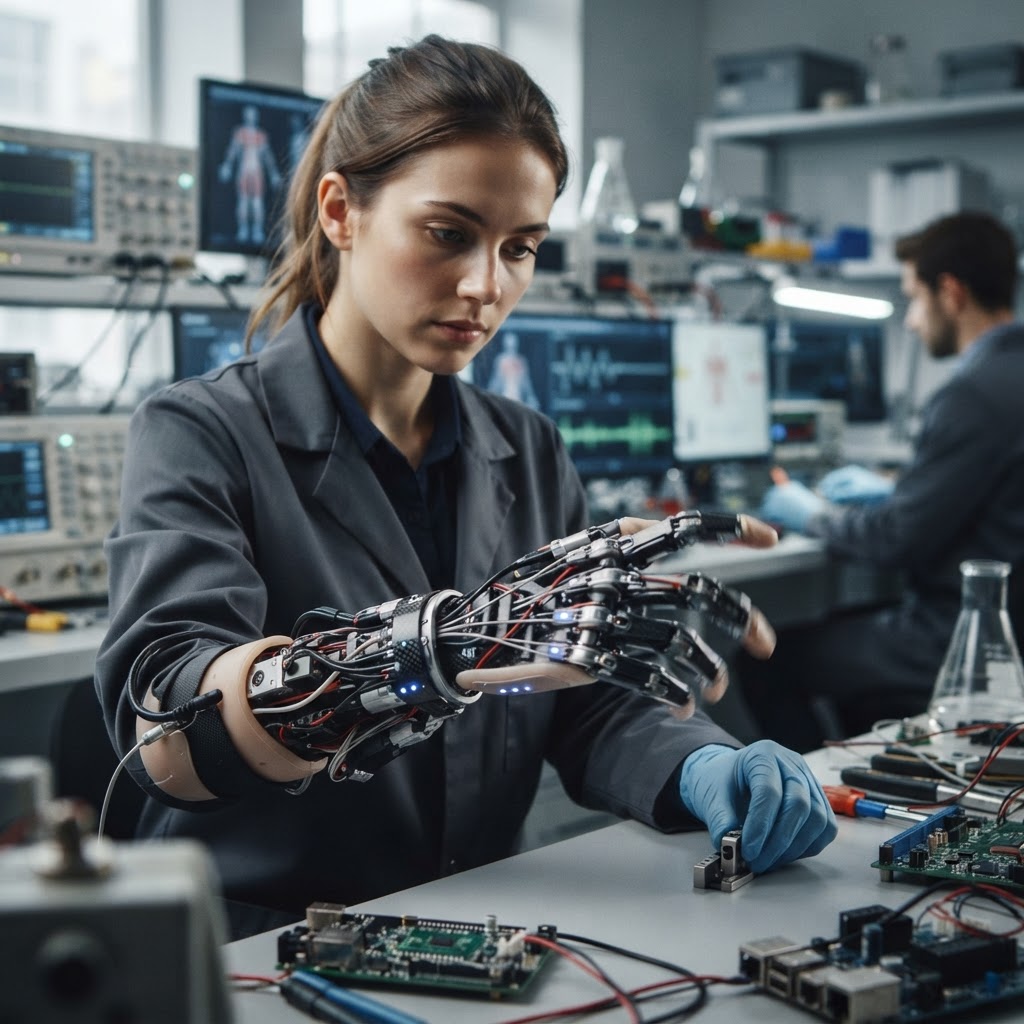
How a Prosthetic Hand Moves
How engineers copy the body's own signals to control a robotic hand.
A prosthetic hand is a replacement for a missing hand — but the clever part is how it listens to the body.
When you want to close your hand, your brain sends an electrical signal down your arm to the muscles in your forearm. Even if the hand itself is gone, those forearm muscles are still there, and they still contract when you think about closing your hand.
Engineers place tiny electrodes (metal sensors) against the skin over those muscles. The electrodes pick up the small electrical spike the muscle makes when it flexes. A tiny computer inside the prosthetic reads that spike and says: "the user wants to close their hand" — so it spins a small motor (a servo) that pulls a cable, curling the fingers shut.
Want to open? A different muscle fires, the computer reads a different pattern, and the motor reverses.
Modern "bionic" hands go further: some connect directly to nerves, so the hand can also send signals back — letting the user feel pressure or grip. That's called sensory feedback, and it's one of the biggest frontiers in biomedical engineering.
The big idea: a prosthetic isn't just a static replacement. It's a two-way translator between the language of the nervous system and the language of motors and code.
Try this at home
Feel your own "electrodes." Place your hand flat on a table, palm up. Now think hard about closing your fist — but don't actually move it. Watch the muscles on the inside of your forearm. You'll see them twitch slightly. That tiny twitch is the same signal a prosthetic reads!
What to notice: the muscle fires before you move. Your body plans the motion first — that's the signal engineers tap into.